Showing posts with label Science. Show all posts

Exploratorium

When you hear a child crying because the don't want to leave a place, that's a very good sign. When, however, after four hours of playing, exploring, interacting and climbing it's you that doesn't want to leave because you have so much more to see, that's an excellent sign. That's understandable though, because the Exploratorium is a truly excellent science centre and I'm so glad to have gone there.

Exploratorium

One of the taglines of the place is, "where the right answer is a question" and it's obvious why this is so. The answer is in the name - Explore-atorium - and visitors are encouraged to let their curiosity reign and enjoy themselves. It is also described as a centre for 'science, art and human perception', so as not to pull apart these very interlinked disciplines and thereby create a holistic experience for all who come through the doors.

Let me start by talking about the staff, as this has been so far the clincher for each place. During the summer, the floors are filled with high school students, and these are the people showing visitors around. You may think this a risky strategy, and it is not without its problems, but it is a socially empowering and laudible one. It creates a learning environment, where if a student doesn't know the answer, they'll work together to find it. It's also showing too that it's OK for people to say, "I don't know", and foster the continuation, "but let's find out."

When school is in session, field trip explainers are the young adults who take over. These guys are there to try out teaching and continue this culture of curiosity. Ken Finn, my host at the Exploratorium, told us that part of the ethos was the feeling that you could become an expert in anything at all and as such the exhibits are designed to pique whichever parts of your interest you choose.

The place can be likened to a forest of phenomena, and it is possible to get overpowered by the potentials within. There are pathways for schoolchildren to find a specific set of interactives about a certain topic, but otherwise the aim of the place is in the name - the Explore-atorium. You can find anything from geometry you can climb on to seminal photography, all based in a warehouse with gothic stone angels watching over.

An important thing to note is that each exhibit is a prototype, designed to be played with, investigated and used. It may not look so 'pretty', but you are immediately hit with the great feeling as a visitor that you can touch the exhibits. It doesn't create as much of a barrier as you maybe get with the 'perfect' interactives in other museums.

They are designed by inventors, people with arts backgrounds, museum studies graduates - any number of people who've come in, started as volunteers and made their way into the workshops. Whilst previously it was a matter of having an idea and going for it, now there are a couple of extra funding layers to get through. However this doesn't stop someone from building a prototype and putting it forward.

One remark here - having the floors stacked with these handling-friendly prototypes means that a lot of things get well used and as such broken. This isn't a problem in the Exploratorium, because the designers are there to see how the public interacts with their ideas in the first place, and it is the whole design team's job to go around and repair whatever is broken outside. Everyone does everything - the ownership of the whole place is shared amongst those who work there and even the visitors themselves.

You may also think that the materials used are somewhat shabby in places as a result of all this handling and discovery. It is true that the centre has a good recycling scheme where people bring in old bits of wood, plastic and so forth and Ken freely admitted that this is because materials are expensive and you have to make do with what you have. There is a great spark of brilliance in looking at what you're given and being challenged to make something from it.

In fact the museum has created cookbooks, telling you how to make exhibits for centres and big schools and the lighter 'snackbooks' have since been written showing smaller scale versions for schools. There have as a result been festivals where schoolchildren have been invited in to get their hands on the workshop and exhibited their own interactives - more social empowerment and community engagement.

The centre has around 600,000 visitors per year, and ten times that amount for online traffic. The website is just like the facility itself, a maze of curiosity that still manages references once the exhibits themselves have finished on the floors, e.g. the science of skateboarding. One way that the hi-tech and low-tech are being linked, for instance, is a microscope in the building being given the functionality to be moved and focused from online.

And what of the exhibits themselves? Well, apart from being very well-handled and touchable, they are extremely simple. One that we saw was simply a black box with a hole in the outside - this demonstrated that dark is the absence of light, as the inside was completely white and yet this couldn't really be perceived through the hole. Another was simply a button labelled "Do not push this button" and a counter showing how many people had. See the pictures above for others.

In short, this has been the perfect place for me to end my trip around North America's science establishments, as it takes the very best of them all and puts it out in its own unique way, without pretention and in a very welcoming, fun way. I have to thank my host, Ken Finn, for taking the time to give me a backstage view of the place and the opportunity to ask all my questions.

An excellent experience, and well worth a visit from anyone in the science communication community.

California ScienCenter

In the heart of Exposition Park in Los Angeles lies the California ScienCenter, a free museum with IMAX and paid exhibitions. It is an imposing structure, although with a small problem of being difficult to find coming from public transport, and is equally breathtaking from the inside with a number of good exhibits and a well thought-out plan behind it.

California ScienCenter

The usual praises are sung - good interactives and friendly staff. Where this particular centre excels is in areas such as the local connection; for instance material unearthed from a landfill by an earthquake was put on display and after 15 years you could still read the print on the paper and so forth. This was part of the Ecosystems exhibition, in which there was also fish from the ocean and so on. As part of the extreme climates, a large block of ice demonstrated the different permeabilities of fabrics and in the desert flash floods showed the fickleness of the land.

One excellent interactive are that particularly springs to mind was the island zone, which demonstrated by means of catapults, air pumps and grappling hooks how difficult it was to get to the island by air, sea and carrier. Another one consisted of different sized balls in a perspex box which visitors had to pull up using different 'beaks', showing the adaptations of birds to their prey. Photos are in the album linked above.

In the section on Egypt and the pyramids, the visitor was challenged to put the pieces of pottery (and thence the story) together for themselves, emulating the work done by the real scientists. This was done very well, with good explanation for you when you finished. A pit with bones was displayed - who used it? Was it a party bin or a burial ground outside a butcher's? Poor or rich? Very well done, and very simple.

So here is a centre that's not afraid to get visitors to think and is also free for everyone to look around. This is why I heartily recommend the California ScienCenter to anyone in the LA area - it's well worth a visit.

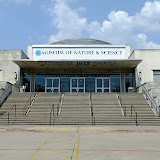
Dallas Museum of Nature and Science

I have to preface this review with the disclaimer that the Museum of Nature and Science in Dallas is moving to a new, bigger facility within two years, which means therefore that not much new investment is going into the current building. This does not mean though that the museum is rundown, but it could in other circumstances be a candidate for quite some refurbishment.

Dallas Museum of Science and Nature

The Museum actually encompasses the Science Centre, Natural History Museum and Children's Museum - being over 6 years' old and childless meant that I couldn't go into that part. The main lobby though is quite impressive, with the planets and their distances in mosaic on the floor and the IMAX projector in the far wall behind glass. There is a planetarium there, but we didn't visit, I'm afraid - as a planetarium worker I've seen Wonders of the Universe and Cosmic Safari far too many times. There were night sky shows too, but my companions had already seen one in Arlington.

The main travelling exhibition was an excellent feature all about water and it's scarcity in fresh form. It gave facts and statistics in clear terminology that related it back to visitors' experiences, had a good amount of interactivity, especially when it came to providing both single player and multiplayer games and quizzes. It put its case clearly and intelligently, and I left it more knowledgeable about water and - most importantly - what I can do to help at home.

Elsewhere one of the popular exhibits with the children is the dino dig - a large sandpit with dinosaur 'remains' buried underneath, but crucially lots of information on how real archaeologists go about putting together a team and preserving what they find. This I noticed in the water exhibition too - signage which told you what you were looking for, what to do and how it works. This simple extra bit of information is crucial, I believe, to a good customer experience.

The DNA exhibition was also excellent, using technology well to get the ideas behind everything across. The Networks exhibition was the exact same one I saw in Ottawa's Museum of Science and Technology, which surprised me slightly, and the human body area was fascinating with simple demonstrations of how much your skin weighs and so on.

The older exhibits looked slightly the worse for wear, and there was some serious glass-case syndrome going on, but this is understandable with the somewhat imminent move to the new facility. The Natural History part of the museum (housed currently in a separate building) still did its job, with a nice polycarbonate cave structure to demonstrate the habitats of bats and other such creatures.

Overall the Dallas Museum of Nature and Science is very good, and an interesting diversion for people of all ages. There is an IMAX and planetarium, and it's relatively inexpensive to go inside. Worth a trip if you're in the area.

Texas update

Over the past ten days I have been in Austin, and have not had an opportunity to do any serious reviewing. I have however visited the Johnson Space Center in Houston, and seen behind-the-scenes thanks to a family contact there. This wasn't, however, a proper tour so I can do no more than to recommend it highly and invite you to read my thoughts at my personal blog, entitled 'Friday 6th - Houston'.

Austin is currently the only major city in the country without a planetarium, and sadly I haven't been able to meet up with Torvald Hessel, the man behind the big push to put this straight. I am very much in favour of getting astronomy and science education out to the public, so the fact that I wasn't able to meet up is a great shame. He recently received a delivery of an inflatable planetarium, and this is a step in the right direction. You can find his website in the links on the right-hand side of this blog.

Finally, I would like to draw readers' attentions to the map of the places mentioned in this blog. This can be found at http://maps.google.com/maps/ms?ie=UTF8&hl=en&msa=0&msid=107633271721151543513.00048d074e5db514ef336&ll=37.09024,-80.683594&spn=31.839416,56.513672&z=4 or from the links on the right-hand side.

Chicago Museum of Science and Industry

From the moment I stepped inside the Museum of Science and Industry in Chicago I was astounded by the scale of the collection I saw before me. To the right, the science of storms; to the left a big mine rig, and in front of me planes and vehicles. Well lit and truly awesome, I knew I was in for a good time at this museum.

Chicago Museum of Science and Industry

The first thing I’d like to consider is how the collection is set out. Museums have a more difficult time of things because they need to balance the collection with the communication, and it’s a difficult balance to strike. It’s hard to avoid glass-case syndrome from the traditional museum ethos because collections need to be preserved rather than used to death. The way Chicago sets things out therefore is to start in the centre with big scientific principles and interactives, then as you head further into its labyrinthine three-storey building, you see more of the collection as a reward for your research.

Of course, as you head away from the centre you do find other excellent interactive rooms, but these are often difficult to find within the building and the signage, though good, is sometimes unhelpful. Nevertheless, there are excellent paper maps and each of the four stairwells is given a different colour to allow easy navigation. Inside these you can also find some old glass cases with exhibits, which gives the impression that they have been relegated here rather than displayed, that they needed somewhere to put them.

Technology has been the downfall of many a science centre, trying to use it as a silver bullet to amaze its visitors. Chicago does an excellent job of using technology wisely and to its best effect, both awing the visitor and also working extremely well to encourage interaction and education. By all accounts the museum has enjoyed a gigantic upgrade in its main areas, and the money has not been wasted. There was, for example, an interactive periodic table projected onto a desk, and you could react different elements together using pucks to ‘pick’ the elements up and slapping them together. A video would then play to show you all about what you have made. Ingenious.

A friend of mine commented that the museum is aimed more at children, with the science of storms exhibit for instance using weather to explain scientific principles, rather than explaining about storms themselves. It’s fair comment, but I can understand why the museum has chosen to do things that way. As communicators we need to use whatever methods we can to get over the basic principles of science in everyday life, and then we can go from there into more depth.

Science shows happen all over the place, including in the entrance hall or main crossroads of the museum. It’s a good way to grab people’s attention and a great space to utilise. The staff I spoke to were friendly and seemed to be well at home with the technology around them. Information panels were also adequate, although seemed to be more erring on the side of giving less information than more.

Overall, this museum is an excellent example for science museums the world over – given the money and space that Chicago enjoys, of course. Nevertheless, the experience is an incredible one, and is well worth a visit, either online or offline. Marvellous.

Great Lakes Science Center

It’s not often you get to see something so well-researched and well-presented as the Great Lakes Science Center in Cleveland, Ohio. Not only does it have an excellent idea of science communication, but it also has a local flavour and uses extremely simple methods to get across its points. The main thing that recommends it though is that it is not shy of using equations and maths.

Great Lakes Science Center

The science communication starts even before you get inside the main body of the building. Within the car park are posted gigantic optical illusions, as well as some of the science behind how the centre is helping in the fight against climate change. This sets the whole visit off to a good start for me, because I like seeing a proactive centre trying to inform at every turn.

For every single exhibit and interactive there is a sign giving full information about what’s going on, what to look for and the principle behind it, thus giving visitors a simple, no-nonsense guide to the reasons for it being there. When describing the catenary arch, the equation y = -a cosh(x/a) was introduced and explained adequately, giving you the salient facts.

Moreover, the centre has taken great steps to make its interactives very simple. For instance, one of the very best I saw was a set of time-lapse photographs stretching back over a year that visitors could cycle through, viewing the weather at any time. Breathtakingly simple, but extremely effective: here you could see a year’s worth of weather, watch the lake being used by the ships and so on. This was magical.

The other big coup for the centre is that the Cleveland home of NASA is being closed down, and therefore that collection is moving into the building. Already the facility is being expanded and the space section is feeling the benefits of the merger. The rest of it will move in for a big opening in summer 2011, and the member of staff I spoke to was very excited about the news. The staff were good, informative and helpful to the degree you’d expect in a customer services role.

Other excellent exhibits that caught my eye included breadboards for learning about electronics simply and in a hands-on way, a sphere and a pyramid filled with balls along with a guide to estimating the number inside and a circular sheet of metal with triangular holes in for directing sunlight onto a surface, deftly showing how a triangle could produce a circular image.

There is a small, inflatable planetarium with a simple cylinder projection system, and also an Omnimax cinema. It doesn’t need to be repeated that I was extremely impressed, because I loved the signage and the simplicity – this truly was a great place for science communication and public interaction, and it can only get better with the inclusion of NASA’s collection too.

Cleveland Museum of Natural History

One of the major quibbles I had with New York's Natural History Museum was its outdated signage (or simply complete lack thereof). Thus when I got to Cleveland I was overjoyed to see that one very thing corrected, that even though there are items in the collection that have been there for many, many years, a change of signage can make even the tiredest old pieces seem fresher and newer.

Cleveland Museum of Natural History

The Natural History Museum also houses a new (one week old at the time of visiting) planetarium and a wildlife area. We were lucky enough to arrive on a 'free day', although $10 is not much to pay for general admission to such a good museum. The planetarium is $4 extra, and is a new Sky-Skan Definiti system with good presenters who are thrilled about its new functionality. They are planning to make sure that the planetarium stays with presenter-led night sky shows which will be brilliant.

The staff were all very helpful and friendly and it is clear that even though the money hasn't been there to finance that many new exhibits, at least new signage has been put around the museum to freshen the place up. My host told me that much of the place hasn't changed in its content, but it was clear that some of the information signs and labels had been updated recently and it really makes the difference.

Outside there are otters, birds and wild cats, all rescue animals that are now being kept safe in the museum. Watching the feeding was popular whilst I was there, and the signboards outside give good information. One of my favourite exhibits within the whole museum though was the Foucault Pendulum in the main hall, which demonstrates the movement of the Earth by knocking over dominos and other toys. Wonderfully visual.

Of course with any museum there will be constant funding issues, especially when a new planetarium has just been built. I can therefore understand that some signs had not been renewed and still looked to be from the 70s and 80s. At least Cleveland has made the effort to update its collection and its signage such that it creates a fresh appearance for the casual visitor. A good museum!

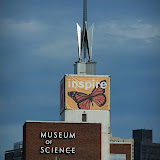
Boston Museum of Science

It was a great disappointment to see that the Hayden Planetarium inside the Boston Museum of Science was closed until early 2011; suffice it to say the rest of the Museum was an absolute delight. Particularly recommended (and seemingly reknowned) is the lightning show, featuring 3-storey Van der Graff generators - an awesome sight, especially when switched on!

Boston Museum of Science

First, the good stuff: The museum covers every aspect of science, from biology and chemistry to physics and maths. The collection is vast, is being renewed very well and combines interactivity with curation very well. There is technology, such as the interactive fish exhibit (which links onto the internet) and lots of writing, such as in the maths section. Interestingly, this is the second museum in which I've seen a section dedicated purely to mathematics - the first was the Cité des Sciences in Paris.

The interactives were likewise excellent - we were able to do Galileo's test of gravity using a big shute, play game theory with money division and biscuits and learn about relativity by pushing a small train along a track and popping a ping-pong ball vertically over the bridge from the carriage. In the section on models, described as an excellent way to show off the miscellaneous items in stock, visitors were presented with the difficult task of creating the shape of an island from the point of view of a visiting mariner.

A new exhibition about the senses gave a fresh look at all five, and included a section on our perception of time. I was particularly impressed by an exhibit that gave a view of a water droplet at different stages of it falling from the mouth of the pipette onto a platform and off it again. This was done with a very short timed flash, that was alterable for the different stages. I also particularly liked the simple demonstration of how fast something can flash by on a screen and still be taken in by the brain.

It also has an exhibition of Escher's work and optical illusions - bigger and more three-dimensional than in books. It asked the question, "Why art at the Museum of Science?" and you can read the reasons they gave in the pictures. The museum doesn't seem afraid to cross traditional boundaries of 'subjects' in order to make its audience think, and this is the mark of good science communication.

The only criticism I can level at the museum is that for some of the older exhibits (such as the mathematics ones) there is a certain amount of knowledge needed for the pieces on display. I was fine to read them because of my mathematical background, but I was drawn to the potential for accessibility issues there. I'm not asking for them to be withdrawn or the writing to be 'dumbed down', but I feel that an entry-level step is needed in addition to provide readers with a better understanding.

My other problem that has surfaced with a number of different institutions - if you are going to provide an email address, make sure that it is monitored. I know that there will be a lot of spam, but for too many facilities I have sent emails to the addresses on the website never to hear back. This is disappointing and definitely not a good state of affairs for any centre, and does not give the best impression.

There is so much more to the Museum of Science in Boston, such as the arteries of a dog laid out in a cabinet, an exhibition on nanoscience as well as the collection of animals and the natural world. You really need a full day at least to take everything in, and there are a number of different membership options which seem to me to be very good value.

Maryland Science Center

Situated in the inner harbour of Baltimore is the Maryland Science Center, an amazing addition to the wealth of urban regeneration within this industrial city. Across the harbour sits the famous aquarium, which I was sadly unable to visit this time round. Nevertheless, the Science Center more than made up for this, and I enjoyed looking at the brilliantly simple exhibits with a sense of childish wonder.

Maryland Science Center

It is an awesome building from the very start, and as you look around the entrance hall you see how varied the science within actually is. Geysers are modelled on both sides as you enter, challenging you to predict when they will blow given the scientific principles behind them. Beneath you in the flooring is the night sky, to your right dinosaurs prowl, to your left the hands-on Newton's Alley makes all sorts of noises.

The principle with this is one of being extremely interactive; there aren't many pieces in the centre that aren't made to be handled, don't have a button to push or whatever. Certainly some of the dinosaurs are there to be appreciated, but even with these there are videos presenting the watcher with various theories behind the beasts - I'm pleased to report I saw no Creationist propaganda there!

I've mentioned that each exhibit is quite simple - I think the best example is of the Wonder Warehouse, where the staff have converted their storage/exhibition space into a giant hotchpotch of different guerilla experiments, from non-Newtonian fluids (cornstarch, water and a sub-woofer) to light painting (with a dark room, a selection of torches and a 20s exposure on the camera). Even the dividers are the very boxes housing their previous travelling exhibit. Everything is used, and the ingenuity shows.

I particularly liked the section on the human body, where very simple principles showed the various functions on the cardiopulmonary, digestive and nervous systems. There was even a simple 'stress monitor', inviting you to guess when your partner is lying whilst trying to guess their number. A sonar gun tells you how tall you are, and elsewhere there is a lab for everyone to try their hands at experiments.

The staff are extremely friendly and are great fun - sadly I can't remember the name of the lady who performed the excellent Laws of Motion show, but it was a tour de force of serious slapstick science presentation. The Davis Planetarium is free, and is a lovely analogue Minolta starball. It is augmented by a series of slide projectors and special effects generators, and provides a great glimpse into the night sky.

If you are in Baltimore, this is definitely a place to visit. If you are not there, then you can follow the centre on Facebook and Twitter, and keep up with its Scicasts, a downloadable podcast of recent news. An excellent centre for the Maryland area.

Bedford Institute of Oceanography

The Bedford Institute of Oceanography is somewhat unique in my list of places to visit in North America. It is not a science centre per se, nor is it a science museum. It is, in fact, a research centre that is welcoming visitors to look around and see what it does. Each tour needs to be booked in advance, and you go around with guides who tailor your visit to each group’s needs.

Bedford Institute of Oceanography

It was truly fascinating for me, an astronomer from the city that is furthest away from the coast in England, to find out more about marine life. They have set things out very well, thinking about both the young and the old in their layout, with options for both when it comes to different groups. Children can find out about erosion, sand and even try to find Wally on more adult level posters.

People of all ages are interested in the Titanic exhibition, showing how the wreckage looked when first discovered and more recently. Onwards from that is the ‘fish lab’, where the public can watch scientists at work and see how the facility is actively trying to help endangered species and find out how to stop invasive ones from spreading. This is real science being done before your eyes, and you can put any questions you have to those who are working there.

What has to be the most fun is the ‘touch tank’, where visitors can even hold some of the specimens used by the institute. This is housed in a shed outside the institute and I got to hold a crab, a scallop and a sea cucumber, and was even introduced to an hermaphrodite lobster that was orange on one side and black on the other. A surreal experience!

At present the tours last one hour and are free; phone booking is essential however. What may come of it in the future I don’t know, because as the remit and facilities expand, an actual science centre may well be built. For now however it is a great way to show local people what is happening both in science and in the bay beside them in the simplest, friendliest way. Full marks for the employment of special tour guides and the opportunity to get down to the shop floor, so to speak.

Halifax Discovery Centre

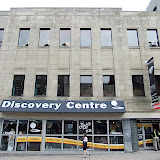
The Discovery Centre started off as a touring science theatre in a van, travelling around Nova Scotia. It remains the only science centre in the province to this day, and still retains the local, community-based feel in a slightly rough-and-ready package. One reason is that the premises were not purpose-built or even designed. It was once a bar, the ‘Misty Moon’ and a department store, so as you can imagine it’s not a huge place at all.

Halifax Discovery Centre

Nevertheless, the Discovery Centre still manages to put a new exhibition on in the main hall three times a year with space for an inflatable planetarium. Science busking happens in the afternoons and workshops in the mornings and after hours their theatre screens HD films and can be hired out for corporate events, seating 65 or letting 75 stand.

This feeling of making do with limited resources extends to the floors as well. As you walk around you notice that a lot of them are sponsored by various companies, and the reason for this is that they lack the funding to do very much at all. What is done is cheap and simple, such as showing the speed of sound by speaking into a funnel, letting the sound waves travel through a long pipe before returning to a point next to your ear. Easy and incredibly effective, especially considering that we can see the pipe and imagine the sound zipping round inside.

Exhibits are brought from other places too, such as Science North. It doesn’t end there; they work with education students from the local Mount Saint Vincent university to train them in workshops and scientific engagement with school groups. They continue to do their community-based workshops and school tours with ‘Science on the Road’, maintaining that link with their origins and hopefully soon extending to Prince Edward Island and Newfoundland.

The centre is popular with locals and tourists alike, and uses some ingenious ways to excite the local media when a new exhibition is on its way. When the Monkeys were there, the centre sent a stuffed chimp to the local press, a Lego set when that one came to town and a candy ring when the current diamonds exhibition arrived. Their programme of summer camps and birthday parties is popular too, and when I spoke to one boy who had just been to a party he said that he had enjoyed it a lot.

The prize for me though was up on the 2nd floor, where the ultimate in engagement with simplicity rested. How do you get people to go around an exhibition about how science and democracy are related? The simple, brilliant way is to build it into a maze. A simple maze granted, but one that is fun enough to attract people’s attention and encourage them to go around and find the various stations. It didn’t require that much building – simple translucent plastic sheeting divided the tracks, which I thought ingenious.

My main thrust in these reviews is, as ever, the staff. Given the budget constraints and lack of funding, they do well with what they have. Everyone there is approachable and relaxed, which is the feeling I get from the place anyway. It is a friendly, local centre, laid-back and community-based, even down to the bicycle-powered radio, which plays a Halifax station when pedalled.

Whilst the building needs to be renovated – and finished – and some of the exhibits were made in the 1970s, there is a good feeling about the place. It does have a foot in new media too, with a presence on facebook and Twitter. So whilst this is not the most up-to-date or flashy science centre I have visited, it is still one that does its best with what it has in the perennial hope of some major source of funding somewhere down the line.

Montréal Science Centre

I have to say that after my experiences through Ontario and the rest of the world the Montréal Science Centre (www.montrealsciencecentre.com) came as a big disappointment. Whilst I said on this blog that I didn’t want to be negative about the centres I visited, I do feel obliged to add balance and say where good science communication principles are not well applied.

Montreal Science Centre

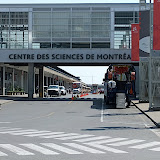
To begin with, the box office lady was friendly and welcoming once I started a conversation with her about yesterday’s Museums Day. As anticipated, the place was packed out, and it was a good day not to visit. I got my wristband and set off down the corridors to find the exhibition halls. The Montréal Science Centre is based in a long, thin building along one of the quays of the Old Port. As such, there is a lot of wasted potential as visitors travel and the signage isn’t particularly good. Some walls have exhibitions on, such as Cargo about shipping in large ports, or details of particularly inventive Quebecans, but I do get the feeling that a lot more could be done.

Here, like the Ontario Science Centre, there is some redemption. In some of the bathrooms there is more about the science of handwashing and facts about leaky toilets, so science is being communicated in these areas too, but I would think that this could be extended to the rest of the building.

It is sometimes seen that technology is the way forward for science communication, and many centres and museums do go overboard in thinking that it has to be on the screen for it to be relevant. Whilst in many instances technology can make a huge difference to the communication of science, misplaced technology can work against the visitor.

The Imagine gallery is a bold attempt to bring in screens, projectors and Minority Report-style interfaces to look into the future of science. Unfortunately this is where things fall down; the user is left waving their hands or trying to drag their feet across the floor to activate a certain display and the sensors seem slow to pick up, or get misplaced signals from somewhere else. There is also very little interactivity – the user is required simply to start things off, and the videos and animations run themselves to the end. There are also very few words, which annoyed me.

One area that showed an excellent use of technology was the idTV station, where people sitting in groups of up to 5 can design a science TV report, bring in all the expert opinions, vox pops and even record their own introductions and conclusions. It was a shame that the acting of the news journalist wasn’t very good at all, but that’s that. This is a fascinating bit of kit in an area that looks like Mission Control, and was truly well done. Sadly there were only a couple of the Interactive Movie games in English and I missed the ones I could visit, so I can’t comment on that, and Mission Gaia was in French and had a large group in as well.

Sex: The Tell-All exhibition was very good indeed, and has been developed by the Montréal Science Centre. It was very refreshing to see sex and sexuality treated with understanding and openness with various stations answering many different questions. Homosexuality for instance, even in the animal kingdom, was handled calmly and with perfect grace, treating it as something perfectly natural, including video interviews with various people from the community.

The main area it seemed for interactive exhibits was Science 26, a gallery full of what were essentially circus stalls for science. It felt bitty, not linked together in a meaningful way and a few of the interactives were not working; some just didn’t want to play by the rules – for example the skateboarding balance machine was impossible to reset and I found myself getting more and more frustrated with how it wouldn’t respond to anything.

It is here that I must mention the one thing I have talked such a lot about in the past about science centres – the staff. So far it has always been the staff that have made the experience, and here was no different. As far as I could tell, the staff were there to guard the entrances to the galleries and were pretty much bored, disinterested and chatting to each other. The vibe they gave off was not one of excitement and engagement, nor one of approachability.

The last thing I would say is that if you have a customer satisfaction policy, as written on the welcome sheet, why should your box office staff be startled and ultimately indifferent when asked for a complaints sheet? This made me wonder; in the centres in Ontario I visited there are customer comment forms and computer screens everywhere, and I couldn’t find a bad thing to say. Here however it was impossible to find such a thing and I wondered if there was a correlation. In any case, I was very disappointed indeed by the Montréal Science Centre and would quite like my money back. Sadly however I doubt I will get that wish fulfilled, based on what I experienced there.

Canada Science and Technology Museum

In 1967 the Canada Science and Technology Museum (CSTM) was opened, housed in a former bakery warehouse. Now one corporation oversees three museums in the city: the Museum of Agriculture, the Museum of Aviation and Space and the Museum of Science and Technology, the last of which still resides in that bakery warehouse, from which they are still looking to move even 43 years on. You can read more about the museum online at http://www.sciencetech.technomuses.ca/english/about/CSTM_Origins.cfm

It was created by a governmental decree; this was the place where Canada’s historical scientific and technological artefacts were to be held and showcased, where it should be shown how science and technology formed Canada and the stories of Canadian heritage could be told. The museum does admirably at this task, and the first thing you encounter as you enter the museum is a big exhibition all about Canadian inventors and how we can also be innovative too.

Canada Science and Technology Museum

This was my first science museum – the previous entries have been about science centres – and it was interesting for me to see the difference in styles between the two. It must be remembered that museums have a collection of pieces that it is up to them to put on display to tell a history; science centres can exist purely on creating new exhibits based on the ideas they want to portray. Ideally there would be a balance between the two – at the Ontario Science Centre I was told that they were looking to bring some objects into exhibitions to show in practice the science that the public was discovering there, and I think science museums can easily use more innovation to engage the public.

Whilst I know that CSTM has only about 2-3% of its collection on show, I do feel that they suffer from a bit of glass case syndrome. Whilst talking to one of the curators I was told that they employ a range of interpretation strategies, from hands-on to text and videos. The staff are fluently bilingual and it was interesting to go around and ask them what their favourite exhibit was, because that shows that they are enthusiastic about their jobs.

It is here I must strike a note of caution, as I was told by one of the staff that they feel underused in some ways in the museum. Unlike Sudbury and Toronto, exhibitions are created by the ‘backroom’ staff, leaving the floor staff purely there as interpreters for the public. According to one worker, their ideas are disregarded completely even though they are the ones on the floor interacting with the public, which is sadly a trait I have seen elsewhere in science museums.

Nevertheless there is a balance to be struck as ever, and CSTM does it in a way that is full of integrity for the curatorial method. Some pieces are collection simply for preservation but not display; other are displayed and some of the problems of putting them on display become useful talking points for discovering the history of the pieces. For example, when showing the inside of a piece, a light was needed, but a light would also damage it over time. A button is chosen for illuminating it for a short time, but that is also used as a way to ask visitors why they think that is the case – problem turned into engagement strategy!

CSTM is a museum for the whole country, and as such needs to serve all four-and-a-half time zones. The internet and new media play a large part in this, and the website contains many education packages for schools and individuals. They have started creating bilingual films about objects within the collection and uploading them to Youtube, which I think is an excellent way to get to see more than just what’s on show in Ottawa. There is also a drive within the museum to find a place on the internet, through social networking, Twitter and so on, and maintain a solid presence.

The museum also owns a mobile planetarium, which is used for schools, camps and evening sessions. It also owns a 15in telescope that is on display and can be viewed on request. Specialised staff provide an expert and fun interpretation for visitors as needed. They also host Café Scientifique meetings on the last Tuesday of each month and Twitter plays a large part in this. The overall thrust in the new media sphere is that they are not there to keep control of their collection, but to be catalysts for dialogue about it, and I think they’ve got exactly the right idea there. Trying to hold back information on the internet is like nailing oxygen to the wall; the best way to use it is to let the air flow freely to enrich the world and let it come back to you in time.

A science museum, as I said, is a different beast from a science centre. It must be said however that no amount of words or interactives will replace the extremely important role that staff play in the visitor experience. It is therefore important to note that those people you meet on the floors must be engaged with their surroundings rather than merely guarding it against the rabble. Science centres do it well by getting the staff to design the space and what goes in it; science museums, in my view, would do well to consider something similar.

CSTM is a good science museum with some excellent interaction strategies, some of the newer exhibitions such as the digital exhibition are particularly well thought-out and designed. It is also extremely good to see a sense of humour within exhibits, and in terms of making Canadians proud of their scientific and technological heritage, I can wholeheartedly recommend the fun, bold and professional way that CSTM works. Well worth a visit!

SNOLAB

In 2003 I wrote a dissertation for degree about the Solar Neutrino Problem and cited (amongst others) Superkamiokande and the Sudbury Neutrino Observatory. Little did I know that seven years later I would be visiting one and talking about the other. It was only a message I sent through the science communication community lists about this blog and project that got me here in the first place; someone emailed me back to say that they worked at Science North and that I should visit, and as a result I found myself in the most incredible lab environment I have ever seen.

You can see my thoughts and feelings about the day on my personal blog entitled ‘2km’ at http://davidault.blogspot.com but here I want to mention some of the science behind the day too and pay homage to the feat of engineering and pioneering skill that I witnessed. It must also be mentioned that work is underway to quadruple the lab’s working space; this too is an eye-opening operation that deserves trumpeting.

SNOLAB

Laboratories, especially those trying to spot minute flashes of light from almost massless particles on their rare interactions with matter, have to be absolutely pristine places. SNOLAB is no different; the air inside the ‘clean’ area of the lab is the same quality, contaminants-wise, as a hospital operating theatre. To accomplish this, large air filters are installed to trap particulates in the atmosphere inside the clean areas. SNOLAB however has another major obstacle to contend with in this regard; it is 6800ft down a working mine, and a similar distance along a very dirty, muddy drift before even reaching the lab.

Everyone must go through the strict protocols of showering before entry into the lab. Your mine clothes are left at the entrance and you are given a set of overalls and boots in which to walk around the clean area, along with a hair band, hard-hat and safety goggles. Blue sticky plastic is laid down at each doorway to trap any dust that may have made its way onto your boots. But why is something as simple as dust so much of a problem in any case? The answer is that down in the rock the dust contains more radioactive particles that, if found in the wrong place, could cause false detections in the experiments.

The original SNO experiment was decommissioned in 2007, but since then the work has moved forward to build on the successes of that original experiment. SNO+ is going to take the original SNO and put a liquid scintillator in place of the heavy water, a task that will require the inversion of the tethering filaments (due to liquid scintillator being lighter than the water around it, heavy water being unsurprisingly the opposite) – again no mean feat.

I should add, at this point, another interesting point of engineering for the company; the cage that ferries the workers down the mine is small, and is designed to fit 44 men in rows of four shoulder-to-shoulder. It is in this space that all equipment must fit or, if necessary, hang beneath the cage – in this instance though the item must be able to be pulled through the opening at operating level. Every piece of equipment must also be cleaned meticulously once it gets into the clean area, or arrive bagged up.

I cannot imagine how many trips were needed to get all the equipment down the mines, nor how many continue to happen each day as the new work is taking place. There are new experiments to search for dark matter particles – PICASSO and DEAP-3600 – and one for a supernova early-warning system called HALO. Many other scientific groups want to use the facility, shielded as it is from cosmic rays by 2km of rock, to collect data, and this is part of the reason behind the expansion.

There will be more information about the SNOLAB and its history from my guide, Dr Fraser Duncan on a future episode of the Jodcast. Suffice it to say, this was a tour of a facility that I will never forget, a chance to see building work happening in challenging surroundings and all thanks to the science communication community. To those of you who read this blog, thank you ever so much, and to Samatha Kuula and Fraser Duncan, my guides, and to Paul Arkilander, my host and chauffeur for the day, my deepest gratitude.

Science North and Dynamic Earth

On the basis of what I saw in Toronto, Ontario Science Centre is a world-class facility for science communication. The trouble with the world, however, is that it is extremely large and if one wanted to get to The Ontario Science Centre from, say, Sudbury, it’s a 5-hour drive there and a similar one back, which isn’t that great for northern Ontario – and as you live further and further north, that 5 hours can increase up to 12 or so. No, northern Ontario needs its own science centre and it is the often overlooked city of Sudbury that has stepped up to that plate.

Science North and Dynamic Earth

Originally merely a staging post between East and West, or a stopover point when travelling by coach from Toronto to Vancouver, Sudbury is an extremely important geological area in its own right. Mined since the late 19th century for its nickel reserves and recognised as the site of an ancient meteorite impact, the city was an ideal choice for northern Ontario’s science centres. In fact, the centres rely heavily and play well with the ideal of the ‘local’ centre.

INCO, the mining company most recently in charge of mining in Sudbury, were at the heart of getting the centres up and running. Whilst it was being built the public were allowed to come in and see the site at weekends, to see how construction was faring. After all, Dynamic Earth is all about mining and Science North uses tunnels to get from one building to the next, and this was a great way for INCO to give the all-important feeling of ownership onto the local community. Once opened in 1984, the centre went from strength to strength, keeping that ‘local’ idea.

The staff, just as in Toronto, are friendly and helpful; dependent on training, they can be anywhere from doing public shows (such as lighting methane bubbles and dropping potassium in water – I was assured that a bigger public programme occurred at weekends) to the more specialised areas or in the planetarium. Some are found on the animal level, demonstrating the local fauna for northern Ontario along with the various climate changes you find there. All the animals housed within the centre are rescue animals that couldn’t survive in the wild.

One excellent idea I found was that the local university, Laurentian, collaborates with the centre to offer the science communication course, on which students learn about how best to work in that environment and design new exhibits which are then used in the centre. There are also more staff hired specifically to make new exhibits, but this is not done in a back room; it is done on the floors where the public can interact with the prototypes and the staff, which I think is an excellent idea. Once again this demonstrates a great deal of passion, enthusiasm and ownership from the staff and a trust of those people who work there.

This trust that gives a lot of autonomy to the presenters also translates to the visitors. For example, whereas in some centres microscopes can only be used with ‘official’ slides, here anything can be put under the lens. That kind of trust in the public is rare and achieves good results, as far as I can see, despite the risks. In fact, another of my favourite exhibits from Science North was the erosion table, where you can build hills and channels to take the rain when it falls heavily upstream (see photos). It was designed so that children could work together and create something together, though apparently more adults than children use it! There is also the ‘cyberzone’ where children can play with telephones and a Nintendo Wii if needs be.

The team behind the centres trade well on their ‘Object Theatres’, from the Nickel City Stories and Refining Theatres at the Dynamic Earth site to the Great Lakes and Club Génome at Science North. These multimedia exhibits combine music, narration, acting and video with objects placed and variously lit throughout the audience’s space, right down to the seats. In the Great Lakes show we sat on pinewood benches and Club Génome was a cheesy, colourful 70s bar complete with appropriate stools. The simple addition of objects really transforms a video into much more of an experience; I’m just sorry I won’t be there to see the Dark Matter one which will open in June.

Science North has a 36-seater planetarium running Digistar 3; I was surprised to see that they had downloaded the Autumn Little List of Constellations from the Digistar Users Group so could enjoy hearing myself sing through the angled dome. It has two projectors and they run a mixture of live and automated shows, with new shows being worked on as the summer progresses.

As I said earlier, whilst Science North trades heavily on the idea of the ‘local’ science centre, they do send a lot of things out on tour to remote places in northern Ontario, from where students cannot get down easily. They have a 6m mobile planetarium and various web resources for teachers and the public. Obviously it is best to get to see how well the designers have used the landscape around them and its uniqueness to create centres that have a real feel of ownership and friendliness. Dynamic Earth, for instance, uses old mining tunnels to show how mining used to be 100 years and 50 years ago. A lot of good thought has gone into them.

My only problems with the centres was the lack of a shuttle bus between the two, although given that no-one would really use public transport to get to either, I can understand that. It is also difficult to see both centres in one day – I would have loved to see a lot more of the Science North centre, but time was pressing to see the mines. Also, I’m not unfit, or at least I don’t think so, but I found that all the attainment scores for the fitness tests in the Body Zone must have been created for androids or similar. Each time I was well subnormal, fitness-wise. Maybe I just am!

Sudbury is a city that has moved from a more mining-based economy to one of science, but in terms of the centres and of the Sudbury Neutrino Observatory. The mining has not gone away from the town, however much the striking workers try to push it, but has now been taken up and given a new lease of life for the public to see what has been going on beneath their city. Long may it continue. This is a city in which Ontario can feel a lot of pride.

Ontario Science Centre

It can only be described as an honour to be shown around a world class science centre, and I have to say that I really have been spoilt having this as my first visit. In fact, my tour will be bookended by what are seen to be the best centres on the continent - the Ontario Science Centre (OSC) in Toronto and San Francisco's Exploratorium in September. The photos from my visit can be found by clicking the link below.

Click here for photos

Basics

The OSC was built for Canada's centennial, opening two years later in 1969, since which time 44 million people have gone through its doors. It was designed to be three seperate buildings linked by bridges and escalators going down into the ravine created by the Don River, giving the feel of going deeper into the engagement of science. This cascade effect works very well, especially when you add that the linking tunnels have open glass walls allowing you to engage with the nature outside the centre as well as the science within.

Experience

One of the problems facing science centres across the world is the internet; why spend your free time and hard-earned money visiting a science centre when you can find out the learning online for free? This was the first question answered by my host, Sara Poirier, who is a researcher and programmer in astronomy and space sciences and has a sparkling history in science engagement. They have been using all the tools at their disposal to innovate and come up with ways to create a Next Generation Science Centre, offering an experience unlike anything online.

It is quite surprising to see people walking around in lab coats, but in goes to exemplify what the OSC does with potential problems - it takes them, turns them around and uses them to its advantage. The public is given a fear of 'science', both by the media and through the generations and so the lab coat can be seen by some to be a barrier, a symbol of that inaccessibility. It is, however what is inside the lab coats that matters. Here are no dusty, old researchers that only talk in jargon, these are young, enthusiastic communicators who engage, enthuse and demonstratively love their jobs.

The staff, I must say, are the OSC's finest asset. All of them are fun, friendly and engaging, and the first three I met on the bottom level were artists. You may wonder why science graduates aren't being insisted upon here - I can answer that from my university days. I was lectured by some of the greatest minds in the country at Cambridge, but they couldn't teach at all. They were trained too much in academia rather than communication. One guy I met was a theatre major and he has been given the opportunity to create theatrical pieces with another colleague for putting on in the centre. Another is an opera singer, and so on. The point is that the Centre is employing people who are naturally communicative and giving them the science; they aren't just taking scientists and hoping they'll learn 'people skills'.

What's more is that the staff are not left in one place to do one thing. All staff are on rotation, from presenting in the planetarium to being on the floors to enrich the visitors' experience. Here again the innovation aspect comes into play; as you enter the Weston Family Innovation Centre (WFIC) you are greeted by a small stage with seats encircling it - the HotSpot. At various times throughout the day a presenter will come along and spend 10-15 minutes talking through the issues of the day. These are found earlier by looking through journals and chosen by the presenters themselves. Here is cutting edge science being explained by the people who are interested in it, and this later goes into the podcast.

The WFIC is a dynamic public interaction space, designed for youth and filled with breathtaking risky collaborative works. The scope is awesome, the interactives very innovative. Where else can you get your face created in tubes of bubbles running from floor to ceiling? What about a cylinder of iron filings suspended in oil which can be magnetised by visitors playing a piano - or, more significantly, plugging in their MP3 player? What is most important though is that all staff from across the building, not just one space, are brought together to brainstorm ideas for this area. We need an interactive to do xyz, let's take some risks and see what we come up with.

This audacity and collaboration takes place within the Challenge Zone, where school and public parties are also given the opportunity to explore real-world situations. A group may be asked, say, to design a flood defense mechanism that is waterproof, windproof, quickly assembled and can fold away easily. They then go off, design their ideas on paper, take them for approval by the quartermaster and then build them from the materials provided. What I appreciated was that this creative process was shared by all staff for the interactives, both online and offline, and that gives a really collaborative feel to the whole building.

Of course, the web is playing a huge part in every museum and public space and like others, the OSC has the opportunity for visitors to make things in the centre and access them online, whether it be results or their stop-motion videos. One story that I was told is that someone brought in a chess set and did a 10 minute stop-motion animation of a game. There is also the feel of the public leaving their mark, with plenty of interactives asking for ideas and opinions - visitors contribute data, which shapes the future experience.

Engagement

Science purists may well be grumbling that I make so much of hiring actors to be the gallery staff and letting them run free to integrate the two disciplines. Another major aspect of the OSC is that scientists are brought in to do research in-house, on the proviso that they give a series of talks to the public during the day. The WFIC hosted a group of scientists researching youth issues with privacy on facebook, on the back of concerns that social media and networking from the centre could have negative effects. Here again the OSC takes a problem and collaborates to investigate it and turns it into engaging science. Another group came in from the Sick Kids hospital to investigate and explain genes and their actions.

The scientists aren't just in-house, however. The OSC partners with local schools and universities to showcase work via flickr and the galleries. A group from York University looking at solar panels came in to design a challenge for the WFIC's Challenge Zone and then could engage with the visitors who turned up. The centre also now host the annual Youth Innovation Award, which has just announced its second winner, who designed a way to refine methane from rural sources and make it usable as fuel.

The engagement is not just for youth and adults - toddlers are allowed an incredible experience in the Kidspark, and the OSC has brought students in from local universities to help show parents where their children are learning from the interactives. Here the whole family is included and shown where the educational growth is happening. This is also evident in the planetarium's new toddler show, which is just as much for the parents' involvement as the childrens'.

Space

Of course, my particular interest is in the astronomy and space areas where Sara and her team have done a marvellous job. The 50-seater planetarium has a Sky-scan twin Zeiss projector and a unique way of seating its 'crew'. At the front of the very intimate space are beanbags for those who want them, or there are benches at the back. The presenter for my show was Rochelle, who communicated the material personably, enthusiastically and with a lot of science, though this was not in any way off-putting. There was a good response from the audience, and justifiably so. There was a mix of real-time night-sky and presenter-led video, and each show as a result is different, because every presenter is different and can tailor their presentation to the audience they have.

Outside in the space section, the fusion of art and science creates a wonderful experience without skimping on any of the detail. Displayed is a quote by Einstein:
The most beautiful thing we can experience is the mysterious. It is the source of all true art and all science.
The meteorites are displayed in the style of a jewellery exhibition, like 'Tiffany's meets Superman's cave'. A piece of Moon Rock and one of Mars Rock sit in adjacent panels which the answers to their FAQ's for all to read.

With all my talk of innovation and new things, the OSC hasn't forgotten its older exhibits. The old planetarium projector is a beautiful old Zeiss analogue piece, but instead of junking it, they have enshrined and labelled it so that it provides a great conversation opener for visitors. The interactive that sticks most in my mind is a gravitational flyby simulator where a ball bearing is rolled down a ramp to a spinning disc, under on side of which is a powerful magnet, simulating a spacecraft being tugged by a planet. If you get the timing right the ball gets hurled to a bell at the end of the box; if not, oblivion awaits. It's an old piece that's been around for years, but it has been renewed and updated to show the ball as Cassini and the disc now shows Venus in orbit around the Sun; the waiting bell is Saturn. A lovely touch, rooted in recent science.

Others

What is great about the OSC is it doesn't seek to lecture you, merely to inform and invite you to play and question. The Question of Truth section talks about scientific bias and what role that plays in our definitions of the world. I felt this particularly apt, because it brought home the fact that although science seeks to find what is objectively true, it can only create a model of the world which is interpreted by our human eyes.

All around the centre, the interactives are well-signed with plenty of information for those who want to read it and short descriptions for those who do not. The balance is pitched perfectly and innovatively. There is even a small rainforest for exploration, and a drinking water taste test, where you can try different waters and vote for which one tastes best. An innovative way to keep visitors hydrated.

Science was, as I said earlier, everywhere. In the toilets I was confronted with a poster saying that men don't wash their hands as much as women and challenging me to redress that balance. It showed me also which areas are most frequently missed when washing, which I thought an amazing bit of engagement. The OSC is full of nice little touches like that, from the two very friendly gentlemen in the Amateur Radio booth to the transparent elevators and escalators which allow you to see the machinery within.

Online

The main OSC website (www.ontariosciencecentre.ca) is clear, informative and gives visitors the opportunity to take a virtual tour before their arrival. Special mention however must go to Redshift Now (www.redshiftnow.ca), which strives to be the science content portal for the centre, combining the elements of innovation with the research and engagement of the scientists who work there. Ken Huxley is the man behind this and he also presents the Redshift Report podcasts which you can find from that site or via all good podcast catchers.

Summary

I think it's fair to say that the OSC has a wonderfully unique way of engaging the public with the science that's in the world around them. I'd certainly love to work there, and that was evident on the faces of all the staff I met whilst I was there. It combines creativity, encourages personal development and really shows what can be achieved when staff are given the freedom to create and play. The fusion of science and wonder is perfect, the pitching level spot on. My only gripe is that it could be better served by public transport, but that's really nothing at all on the scale of how much of a world leader this place is.

Special thanks once again must go to Sara, Ken, Tyler, John, Rochelle, Heidi, Walter and everyone else whom I met there. I had an incredible time and left buzzing with ideas and potential. That is the mark of a great science centre, and all credit to you.