Dallas Museum of Nature and Science

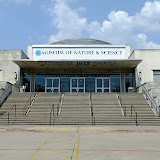
I have to preface this review with the disclaimer that the Museum of Nature and Science in Dallas is moving to a new, bigger facility within two years, which means therefore that not much new investment is going into the current building. This does not mean though that the museum is rundown, but it could in other circumstances be a candidate for quite some refurbishment.

Dallas Museum of Science and Nature

The Museum actually encompasses the Science Centre, Natural History Museum and Children's Museum - being over 6 years' old and childless meant that I couldn't go into that part. The main lobby though is quite impressive, with the planets and their distances in mosaic on the floor and the IMAX projector in the far wall behind glass. There is a planetarium there, but we didn't visit, I'm afraid - as a planetarium worker I've seen Wonders of the Universe and Cosmic Safari far too many times. There were night sky shows too, but my companions had already seen one in Arlington.

The main travelling exhibition was an excellent feature all about water and it's scarcity in fresh form. It gave facts and statistics in clear terminology that related it back to visitors' experiences, had a good amount of interactivity, especially when it came to providing both single player and multiplayer games and quizzes. It put its case clearly and intelligently, and I left it more knowledgeable about water and - most importantly - what I can do to help at home.

Elsewhere one of the popular exhibits with the children is the dino dig - a large sandpit with dinosaur 'remains' buried underneath, but crucially lots of information on how real archaeologists go about putting together a team and preserving what they find. This I noticed in the water exhibition too - signage which told you what you were looking for, what to do and how it works. This simple extra bit of information is crucial, I believe, to a good customer experience.

The DNA exhibition was also excellent, using technology well to get the ideas behind everything across. The Networks exhibition was the exact same one I saw in Ottawa's Museum of Science and Technology, which surprised me slightly, and the human body area was fascinating with simple demonstrations of how much your skin weighs and so on.

The older exhibits looked slightly the worse for wear, and there was some serious glass-case syndrome going on, but this is understandable with the somewhat imminent move to the new facility. The Natural History part of the museum (housed currently in a separate building) still did its job, with a nice polycarbonate cave structure to demonstrate the habitats of bats and other such creatures.

Overall the Dallas Museum of Nature and Science is very good, and an interesting diversion for people of all ages. There is an IMAX and planetarium, and it's relatively inexpensive to go inside. Worth a trip if you're in the area.

Arlington Planetarium

There is a point where large planetaria become too big, and the intimacy is lost. The new planetarium at the University of Texas in Arlington however manages to strike the balance between big and intimate, with its 150-seater 60' dome, run with the new Digistar 4 system from Evans and Sutherland. 6 DLPs run the planetarium, and once the lights and other effects are plugged back in, they will have quite the venue.

In fact, Arlington Planetarium has managed to do many different things within its walls - for example, $300 will get a couple two hours under the stars, dinner and wine for the perfect romantic evening. A brilliant use of the space (no pun intended) and so simple to boot. Then again there is something to be said for having an open central aisle for that kind of event to take place.

As the planetarium is part of the university, it benefits from being a university department, and so equipment can be requisitioned as and when other departments are finished with it. This has very much helped with keeping the computers powerful enough to handle the transition from D3 to D4. The whole planetarium is finishing its upgrade, so that there will be more exhibits outside for visitors. At present they have screens linked to a nationwide science reporting system, which does a very good job.

The shows tend to be an hour long - sometimes all presenter-led, sometimes beginning with a presenter-led night sky segment, then going on to an automated show. This works very well, and with a planetarium this size it's easy to put on fewer shows. Another point is that the planetarium team itself is quite small - only 3 people - but with a university there, it's easy to get students in to train up as educators.

Students are a great source of audience too; at the beginning of the year the planetarium offers cut-price tickets for students, as well as other such benefits. Live music nights and party evening use the aforementioned lights. It's an excellent resource, and it seems to be well used too. In fact, the astronomy department uses the smaller planetarium on site for labs and teaching, leaving the larger one for shows. In general a public show will only just more than half fill the place, which is a shame. It deserves to be a lot fuller.

The Planetarium at UT Arlington is a really great facility and very much worth the while to visit if in the Dallas/Fort Worth area. I'm much indebted to Amy Barraclough for showing me around and explaining the great things that the planetarium has done and will continue to do. Great stuff.

Texas update

Over the past ten days I have been in Austin, and have not had an opportunity to do any serious reviewing. I have however visited the Johnson Space Center in Houston, and seen behind-the-scenes thanks to a family contact there. This wasn't, however, a proper tour so I can do no more than to recommend it highly and invite you to read my thoughts at my personal blog, entitled 'Friday 6th - Houston'.

Austin is currently the only major city in the country without a planetarium, and sadly I haven't been able to meet up with Torvald Hessel, the man behind the big push to put this straight. I am very much in favour of getting astronomy and science education out to the public, so the fact that I wasn't able to meet up is a great shame. He recently received a delivery of an inflatable planetarium, and this is a step in the right direction. You can find his website in the links on the right-hand side of this blog.

Finally, I would like to draw readers' attentions to the map of the places mentioned in this blog. This can be found at http://maps.google.com/maps/ms?ie=UTF8&hl=en&msa=0&msid=107633271721151543513.00048d074e5db514ef336&ll=37.09024,-80.683594&spn=31.839416,56.513672&z=4 or from the links on the right-hand side.

Chicago Museum of Science and Industry

From the moment I stepped inside the Museum of Science and Industry in Chicago I was astounded by the scale of the collection I saw before me. To the right, the science of storms; to the left a big mine rig, and in front of me planes and vehicles. Well lit and truly awesome, I knew I was in for a good time at this museum.

Chicago Museum of Science and Industry

The first thing I’d like to consider is how the collection is set out. Museums have a more difficult time of things because they need to balance the collection with the communication, and it’s a difficult balance to strike. It’s hard to avoid glass-case syndrome from the traditional museum ethos because collections need to be preserved rather than used to death. The way Chicago sets things out therefore is to start in the centre with big scientific principles and interactives, then as you head further into its labyrinthine three-storey building, you see more of the collection as a reward for your research.

Of course, as you head away from the centre you do find other excellent interactive rooms, but these are often difficult to find within the building and the signage, though good, is sometimes unhelpful. Nevertheless, there are excellent paper maps and each of the four stairwells is given a different colour to allow easy navigation. Inside these you can also find some old glass cases with exhibits, which gives the impression that they have been relegated here rather than displayed, that they needed somewhere to put them.

Technology has been the downfall of many a science centre, trying to use it as a silver bullet to amaze its visitors. Chicago does an excellent job of using technology wisely and to its best effect, both awing the visitor and also working extremely well to encourage interaction and education. By all accounts the museum has enjoyed a gigantic upgrade in its main areas, and the money has not been wasted. There was, for example, an interactive periodic table projected onto a desk, and you could react different elements together using pucks to ‘pick’ the elements up and slapping them together. A video would then play to show you all about what you have made. Ingenious.

A friend of mine commented that the museum is aimed more at children, with the science of storms exhibit for instance using weather to explain scientific principles, rather than explaining about storms themselves. It’s fair comment, but I can understand why the museum has chosen to do things that way. As communicators we need to use whatever methods we can to get over the basic principles of science in everyday life, and then we can go from there into more depth.

Science shows happen all over the place, including in the entrance hall or main crossroads of the museum. It’s a good way to grab people’s attention and a great space to utilise. The staff I spoke to were friendly and seemed to be well at home with the technology around them. Information panels were also adequate, although seemed to be more erring on the side of giving less information than more.

Overall, this museum is an excellent example for science museums the world over – given the money and space that Chicago enjoys, of course. Nevertheless, the experience is an incredible one, and is well worth a visit, either online or offline. Marvellous.

Great Lakes Science Center

It’s not often you get to see something so well-researched and well-presented as the Great Lakes Science Center in Cleveland, Ohio. Not only does it have an excellent idea of science communication, but it also has a local flavour and uses extremely simple methods to get across its points. The main thing that recommends it though is that it is not shy of using equations and maths.

Great Lakes Science Center

The science communication starts even before you get inside the main body of the building. Within the car park are posted gigantic optical illusions, as well as some of the science behind how the centre is helping in the fight against climate change. This sets the whole visit off to a good start for me, because I like seeing a proactive centre trying to inform at every turn.

For every single exhibit and interactive there is a sign giving full information about what’s going on, what to look for and the principle behind it, thus giving visitors a simple, no-nonsense guide to the reasons for it being there. When describing the catenary arch, the equation y = -a cosh(x/a) was introduced and explained adequately, giving you the salient facts.

Moreover, the centre has taken great steps to make its interactives very simple. For instance, one of the very best I saw was a set of time-lapse photographs stretching back over a year that visitors could cycle through, viewing the weather at any time. Breathtakingly simple, but extremely effective: here you could see a year’s worth of weather, watch the lake being used by the ships and so on. This was magical.

The other big coup for the centre is that the Cleveland home of NASA is being closed down, and therefore that collection is moving into the building. Already the facility is being expanded and the space section is feeling the benefits of the merger. The rest of it will move in for a big opening in summer 2011, and the member of staff I spoke to was very excited about the news. The staff were good, informative and helpful to the degree you’d expect in a customer services role.

Other excellent exhibits that caught my eye included breadboards for learning about electronics simply and in a hands-on way, a sphere and a pyramid filled with balls along with a guide to estimating the number inside and a circular sheet of metal with triangular holes in for directing sunlight onto a surface, deftly showing how a triangle could produce a circular image.

There is a small, inflatable planetarium with a simple cylinder projection system, and also an Omnimax cinema. It doesn’t need to be repeated that I was extremely impressed, because I loved the signage and the simplicity – this truly was a great place for science communication and public interaction, and it can only get better with the inclusion of NASA’s collection too.

Cleveland Museum of Natural History

One of the major quibbles I had with New York's Natural History Museum was its outdated signage (or simply complete lack thereof). Thus when I got to Cleveland I was overjoyed to see that one very thing corrected, that even though there are items in the collection that have been there for many, many years, a change of signage can make even the tiredest old pieces seem fresher and newer.

Cleveland Museum of Natural History

The Natural History Museum also houses a new (one week old at the time of visiting) planetarium and a wildlife area. We were lucky enough to arrive on a 'free day', although $10 is not much to pay for general admission to such a good museum. The planetarium is $4 extra, and is a new Sky-Skan Definiti system with good presenters who are thrilled about its new functionality. They are planning to make sure that the planetarium stays with presenter-led night sky shows which will be brilliant.

The staff were all very helpful and friendly and it is clear that even though the money hasn't been there to finance that many new exhibits, at least new signage has been put around the museum to freshen the place up. My host told me that much of the place hasn't changed in its content, but it was clear that some of the information signs and labels had been updated recently and it really makes the difference.

Outside there are otters, birds and wild cats, all rescue animals that are now being kept safe in the museum. Watching the feeding was popular whilst I was there, and the signboards outside give good information. One of my favourite exhibits within the whole museum though was the Foucault Pendulum in the main hall, which demonstrates the movement of the Earth by knocking over dominos and other toys. Wonderfully visual.

Of course with any museum there will be constant funding issues, especially when a new planetarium has just been built. I can therefore understand that some signs had not been renewed and still looked to be from the 70s and 80s. At least Cleveland has made the effort to update its collection and its signage such that it creates a fresh appearance for the casual visitor. A good museum!

American Museum of Natural History

One of the most impressive parts of the Museum of Natural History in New York City is the Hayden Sphere within the Rose Centre for Space. It serves as a planetarium and exhibition space (although the latter was closed at the height of the summer holiday), but also as an extremely good tool for an exhibit all about scale in the universe, from galaxy superclusters to atoms. Sadly, the rest of the museum just wasn’t up to scratch and I found myself deeply disappointed by the whole place, so much so that I find myself trying to search for positives to balance out the negative experience I had there.

American Museum of Natural History

Admission is on a pay-what-you-want basis, but if you don’t want to pay the recommended $16 you have to join the long queue of people waiting to be served. We chose to use the faster ticket machines, and I mistakenly selected a senior ticket rather than a student ticket for my friend. It didn’t mean any change of price ($12 for each category) but it didn’t matter anyway. They didn’t check our tickets as we walked in, and I could have just held up a receipt for anything for all it mattered. Security was a joke and the ticket inspectors were as bored as the rest of the staff.

Out on the floors there were big exhibits offline (such as the Big Bang in the Hayden Sphere) and several touchscreens that were not working or even smashed. One set of three videos had one rotated left, one right and one upside-down and all at least six inches below the line they should be. Plenty of places had inscriptions marked ‘press here’ and no buttons to press, or signboards that you could get your hand inside. Believe me, the metal underneath was sharp, and could be a potential litigation point should anyone else realise this.

One big beef I had was the lack of signage about the place – I ended up having to go back out through the ticket barriers to find the toilets, necessitating another useless waving of my receipt in the guard’s general direction. Another interactive that can be spun to show cloud motion on planets had absolutely nothing to tell visitors what it was, so they just span it and that was it. Staff were few and far between, mostly looking bored and none really looking too outgoing.

The museum’s signboards also seemed to assert that there was some problem with the definition of a planet, trying to edge Pluto somewhat unscientifically back into the club. There were also flashing lights where there didn’t need to be (for example for demonstrating the process for fusing hydrogen into helium) and not in other places. There were plenty of places to shop, however, and you could purchase Astronaut Barbie with a variety of hair colours should you wish it.

The rest of the museum looks old and desperately needs updating. The exhibit signs for example in the New York state wildlife area are very dated and would do well for a change of font and a lick of paint. The biodiversity exhibition was horrendously underlit, and several text boxes were impossible to read. In the human evolution section the lit text panels were flickering enough to make my friend feel ill.

For the good points, they had a big screen with the latest scientific news in the Rose Centre, and also within Biodiversity. The human evolution section was very well done indeed, and as I said earlier I thought the use of the Hayden Sphere as a reference point on the scaling exhibit was excellent: ‘if the Hayden Sphere was the size of x, the model in front of you is the size of y’, and so on. This was a very tangible and appreciable way to put things in perspective. The meteorite hall too contained some excellent articles, and I was very impressed with the range of rocks and the text that accompanied them.

I went back to the museum to watch ‘Sonic Visions’ a 35-minute long series of pop/rock/electronic tracks set to psychedelic visuals on the planetarium dome. It’s a beautiful planetarium, and I’m sure given the right audience it could be a hit. The trouble was that it became too samey, and after 10 minutes I wanted to see something different, using more of the space within. I expected better, especially considering the excellent astronomy shows the AMNH exports.

Once again, here was an institution that did not return my emails, which annoyed me. I know it’s the summer, and that means the busy period, but it doesn’t do these places any good to ignore their clientele. Very disappointing as a whole museum – I’m sure that there is plenty of excellent material within those many walls, but sadly I missed it behind the overall experience.